
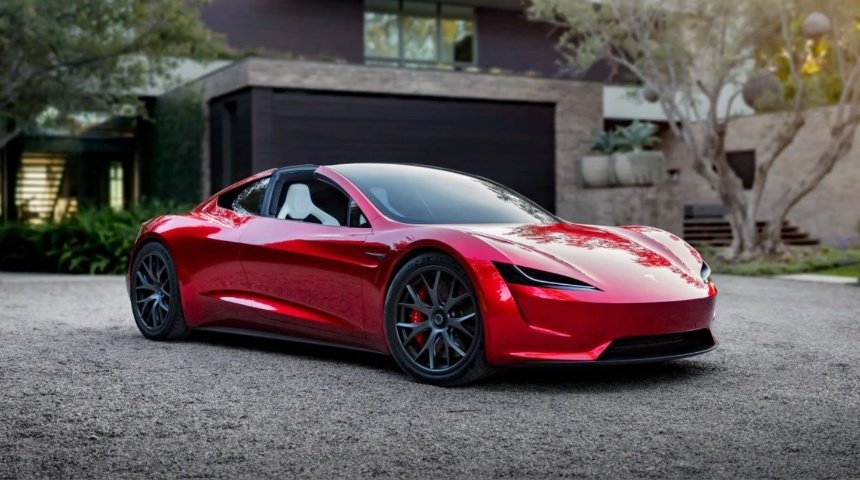
Tesla has finally brought its long-delayed Roadster back into the spotlight, and this time the headline feature is something rarely associated with a car: rocket-style thrusters. The redesigned electric sports car appeared at a SpaceX facility in Texas on October 15, where a demonstration showed it driving upside down on a ramp before launching into the air and landing on its wheels. Tesla says production is planned for 2028. The company has yet to reveal the final price, however, and the spectacular demonstration does not mean customers will be getting a flying sports car anytime soon.
A Very Different Tesla Roadster
When Tesla first showed the next-generation Roadster in 2017, it promised a four-seat electric sports car with extraordinary acceleration and a range of up to 620 miles. The car shown this month has taken a different direction. The redesigned version has two seats in its regular configurations, while the most extreme Rocket version is a single-seater. Its biggest visual talking point is also its technology: fans beneath the body help create suction, allowing the demonstration car to travel along an inverted ramp. SpaceX-developed compressed-air thrusters then helped the vehicle perform mid-air manoeuvres during the event. The display was certainly dramatic, but Tesla has not yet provided enough production details to establish how much of the technology will be practical for everyday owners.
Tesla Roadster Price: What Buyers Need to Know
Tesla has not announced an official purchase price for the 2026 Roadster. The original car was advertised at USD 200,000, with a Founders Series priced at USD 250,000, but those figures date back to 2017 and should not be used as current pricing. Tesla is now accepting reservations for the new Performance and Thrust configurations. Reported reservation payments are USD 50,000 for Performance and USD 250,000 for Thrust, while the Rocket version is available by invitation. These are reservation amounts, not the final vehicle prices. Tesla has also warned in its reservation terms that delivery timing is not guaranteed. Buyers should review the latest agreement carefully before committing a substantial amount of money to a car whose production version has not yet reached customers.
SpaceX Thrusters and Performance
The Roadster’s most eye-catching claims involve speed and the ability to perform controlled aerial manoeuvres. Tesla has shown a 0–60 mph demonstration in under one second and says the car can exceed 230 mph. The company also lists a range of around 300 miles, considerably below the 620-mile figure promoted with the original concept. Three versions are planned: Performance, Thrust and Rocket. Performance is the road-focused model, Thrust adds rear-mounted acceleration thrusters, and Rocket features a more extensive thruster system and is restricted to selected buyers. Tesla has not independently demonstrated every claimed capability under normal driving conditions, and the public-road legality of some features remains a significant question. The demonstration proves that Tesla has built an unusual prototype; it does not settle how the finished car will perform outside a controlled test environment.
When Will the Tesla Roadster Go on Sale?
Tesla is targeting 2028 for the start of production, but it has not announced a firm customer delivery schedule. That distinction matters because the Roadster has missed several deadlines since its original unveiling. Production was once expected in 2020, then moved through later target dates as the project continued to evolve. The latest reveal gives buyers a much clearer look at the car Tesla is pursuing, but it does not guarantee that deliveries will begin on time. The company has yet to confirm final pricing, complete production specifications or availability dates for individual markets. For now, 2028 remains Tesla’s stated production target rather than a confirmed delivery date.
What Happens Next?
The Roadster is intended to showcase Tesla’s engineering ambitions more than its ability to sell large numbers of cars. Its thrusters and suction system make it unlike a conventional electric supercar, but they also raise practical questions about cost, maintenance, safety and road approval. The next meaningful update will be one that answers those questions with final specifications, pricing and a credible production schedule. Until then, the Roadster remains one of Tesla’s most ambitious projects—and one that buyers have been waiting years to see reach the road.
Disclaimer: Performance figures and production plans are based on Tesla’s claims and may change before customer deliveries begin.